
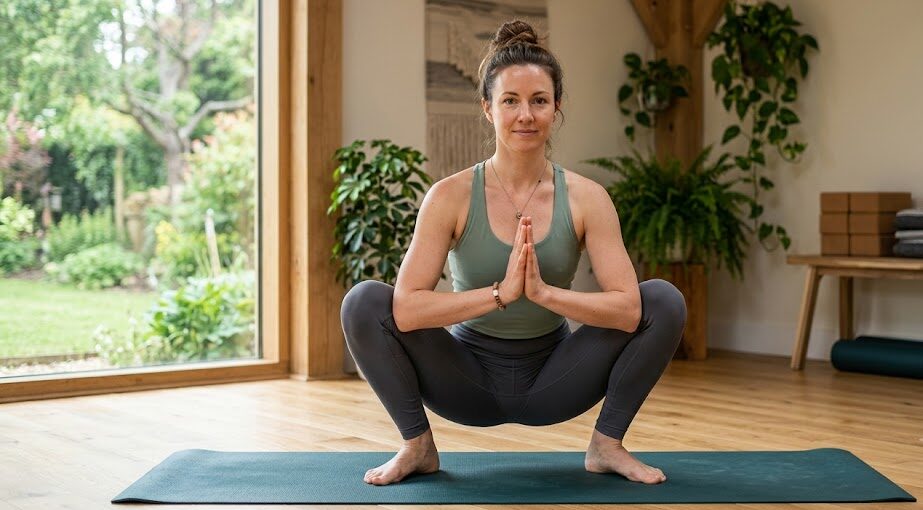
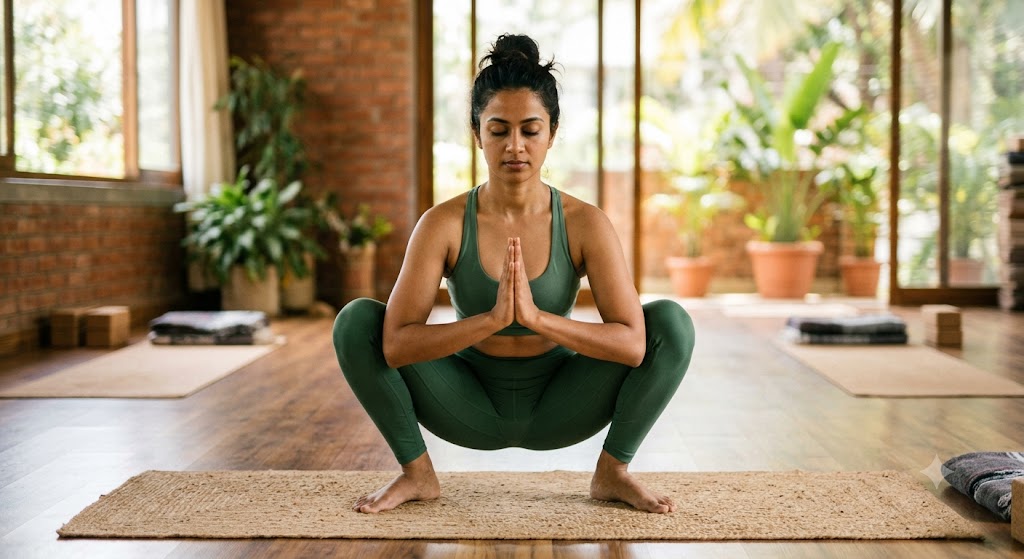
Malasana, also called Garland Pose or Yogic Squat, is a deep squatting posture in which the hips move toward the floor while the feet remain grounded. In yoga, Malasana is commonly used to work on hip mobility, ankle mobility, balance, lower-body strength, and pelvic awareness.
It is also an interesting posture from a modern biomechanics perspective. The deep hip and knee flexion resembles the squatting posture humans naturally use for many everyday tasks and it has similarities to the posture used for squatting-style defecation.
But Malasana is not simply a “stretch.” It requires coordinated movement at the ankles, knees, hips and spine, and your ability to perform it comfortably can depend on mobility, strength, proportions and previous injuries.
Medical note: Malasana is a yoga posture, not a treatment for constipation, pelvic-floor disorders, pregnancy complications or other medical conditions. If you have pain, significant constipation, pelvic-floor symptoms, an injury, or a high-risk pregnancy, speak with an appropriately qualified healthcare professional before using Malasana therapeutically.
Table of Contents
What Is Malasana Or the Garland Pose?
Yoga Malasana is also known as the “Upavesasana,” the “Squat Pose” or “Garland Pose”. The word Malasana is originally taken from two Sanskrit words, where “Mala” means ‘Garland’ or ‘Necklace’ or ‘Rosary’, and “Asana” means ‘Pose’. Malasana is generally pronounced as “maa-laa-sa-na”.
Malasana yoga pose is simply a squat. Kids and individuals who generally work and play in the fields practice the Malasana squats. However, those working in an office, i.e., desk jobs, are away from the practice of squatting and thus find Malasana squats uncomfortable and painful to perform.
Do not get disappointed and stop practicing Malasana squats because Malasana benefits are many; especially Malasana, or the Garland Pose, is very beneficial to those individuals who lead a sedentary lifestyle.
Unlike a conventional gym squat, Malasana is generally practiced as a static yoga posture, although it can also be used dynamically as part of a mobility sequence.
Why Does One Need To Practice Malasana Squats Or Garland Pose?
Malasana squatting was generally a usual pose for our ancestors. Over their normal practice of squats and daily routine, they were content with keeping their upper legs and torso hinged at a 160° angle.
At the present time, many of us have to sit in cars or chairs all day long. Consequently, we are more relaxed having the body set at a 90° angle rather than a 160° angle.
Therefore, we slouch, and we sit; slowly, but certainly, losing our mobility in our back and hips. Unknowingly, our pose is bringing a wide range of strength and health problems in life.
Fortunately, common practices of the Malasana squats keep our joints healthy for the long term.
What Are The Preparatory Poses Of Malasana Or The Garland Pose?
These are the preparatory poses of Malasana. Practice these preparatory poses to get the most Malasana benefits:
- Upavistha Konasana (उपविष्ठ कोणासन) Or The Wide-Angle Seated Forward Bend Pose
- Baddha Konasana (बद्धकोणासन) Or The Cobbler Pose or Butterfly Pose
- Virasana (वीरासन) Or The Hero Pose
How To Practice The Malasana Pose Or The Garland Pose?
Malasana is basically a squat pose. It is very simple if you follow the step-by-step instructions for the Malasana steps carefully. Let’s check out the Malasana pose steps below.
Instructions for Malasana Steps:
- To do the Malasana pose, begin with a low squat form with the feet as close together as possible
- Try to keep the feet flat on the floor (You can also use a yoga block or a folded yoga mat to comfortably touch the ground with your feet
- Spread the thighs as wide as possible or just wider than the torso so that you can bend forward to bring the torso between the thighs
- Place both palms together in front of your chest in a prayer position
- Exhale to develop into the pose
- Press the elbows against the inner shins or knees to create confrontation between the elbows and your inner legs
- Lengthen your torso at the front while you squeeze the inner thighs into each other
- Take a twist if you wish to transfer deeper
- You can also spread your hands backward and hold onto or just keep your hands under the heels to improve posture
- Hold on to this position for at least 30 to 60 seconds or as per your capability
- Slowly get back to your previous position and then relax for some time.
Tips For Beginners On The Malasana Pose:
If Malasana squatting seems to be difficult for you, then do this:
- Sit on the front edge of the chair and form a right angle with your thighs to your torso
- Place the feet on the ground faintly ahead of the knees
- Bend forward from the torso between your thighs
If you want to do the asana on the floor but are unable to reach the floor with the heels, then do not force too much; instead of forcing, rest your heels on a yoga block or on a folded yoga blanket.
What Are The Follow-Up Poses Of the Malasana Pose?
Here are the follow-up poses of the Malasana pose. Check out the follow-up poses of the Malasana steps:
- Bhujangasana (भुजङ्गासन) Or The Cobra Pose
- Adho Mukha Svanasana (अधोमुखश्वानासन) Or The Downward-Facing Dog Pose, Down Dog, Or Downward Dog
- Uttanasana (उत्तानासन) Or The Intense Forward-Bending Pose OR Standing Forward Bend OR Standing Head to Knees Pose OR Standing Forward Fold Pose OR Intense Stretch Pose
Contraindications & Cautions Of The Malasana Pose?
These are the cautions you need to know before practicing the Malasana pose to get the most Malasana benefits.
- If you have lower back pain or an injury in your lower back, then do not practice the Malasana pose.
- If you have knee pain or an injury in your knee, then maintain a distance from the Malasana pose.
What Are The Malasana Benefits:
These are the Malasana benefits that you get from the regular practice of this asana. Check out the benefits of Malasana below:
Malasana Benefits For Flexibility:
Malasana benefits give the sacrum, lower back, hips, and groin a good stretch while performing the posture. Consequently, it brings flexibility to these areas and provides relief from problems related to these areas.
Malasana Benefits Instigates Metabolism:
As the Malasana involves many stretches, regular practice of this asana can help with weight loss and instigate the metabolism.
Malasana Benefits For Better Digestive System:
Malasana benefits activate the digestive system by creating a stretch in the abdominal area and on the stomach. It improves blood flow in the stomach and improves the digestive system to a great extent.
Malasana Benefits For A Toned Belly:
The regular practice of Malasana allows us to achieve a flat and toned belly. So for a toned belly, you do not have to go to the gym; just practice Malasana regularly to see the changes within weeks.
Malasana Variations:
There are a total of 8 Malasana variations. Know all these yoga squat variations to get the full Malasana benefits. Here we go…
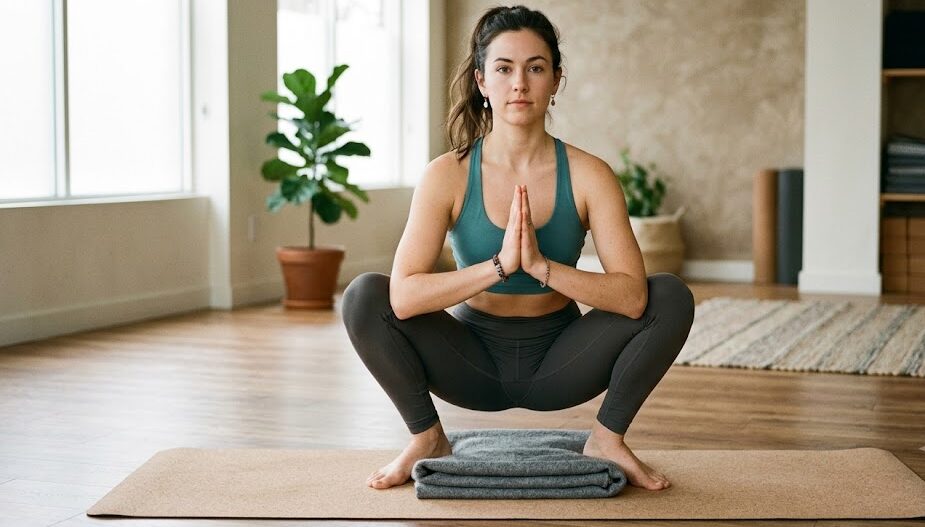
1. Supported Malasana with Heels on a Blanket:
Place a folded blanket or yoga mat underneath the heels.
This is one of the simplest ways to make Malasana accessible when ankle mobility is limited.
How to practice:
- Stand with the feet comfortably apart.
- Turn the toes slightly outward.
- Lower into a squat.
- Place the heels on the folded blanket.
- Bring the hands together at the chest.
- Keep the spine long and breathe slowly.
Best for: beginners and people who cannot comfortably keep their heels grounded.
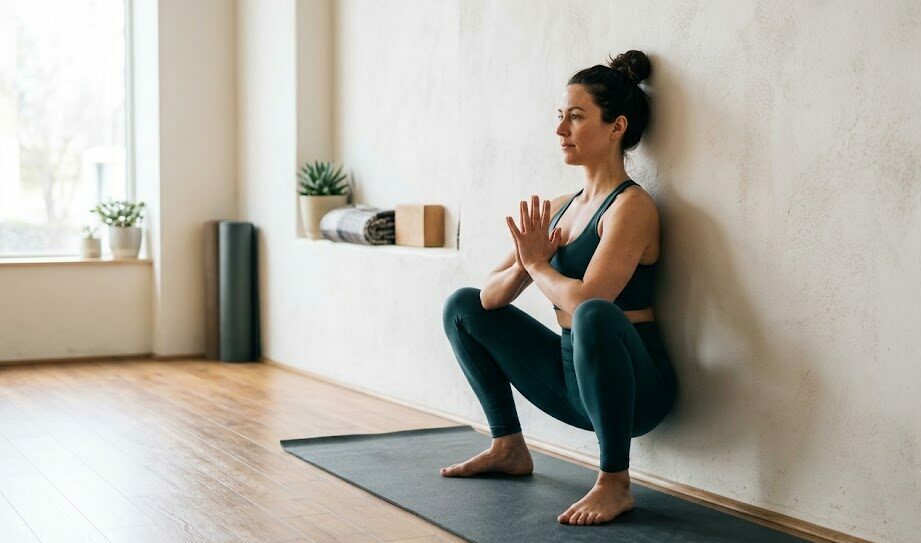
2. Malasana with the Back Against a Wall:
Stand with your back near a wall and descend into a supported squat.
The wall gives you additional balance and confidence.
Best for: beginners, balance practice, and people learning the sensation of deep hip flexion.
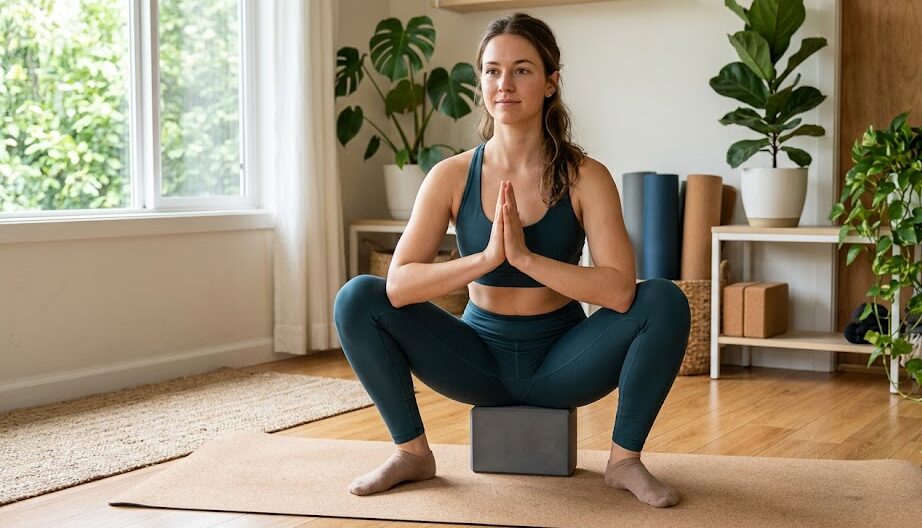
3. Malasana with a Block Under the Hips:
Place a yoga block, bolster, or firm cushion underneath the sitting bones.
Instead of holding your full body weight at the bottom of the squat, allow the prop to provide support.
You should feel supported, not compressed.
Best for: beginners, reduced mobility, and longer holds.
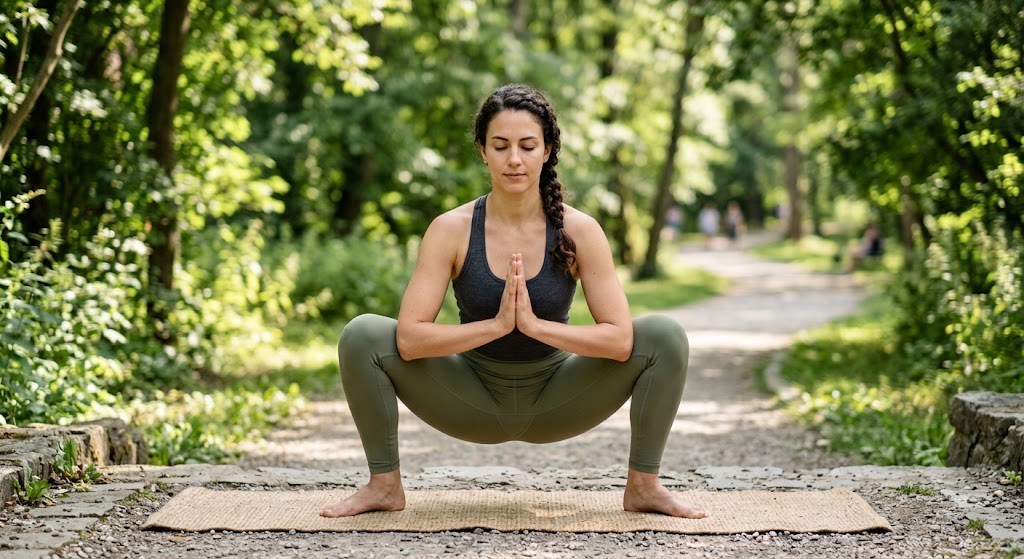
4. Wide-Leg Malasana:
Take the feet wider than your usual squat stance and allow the knees to track in the same general direction as the toes.
This can create more space for the torso between the thighs.
Best for: people who feel restricted in a narrow squat.
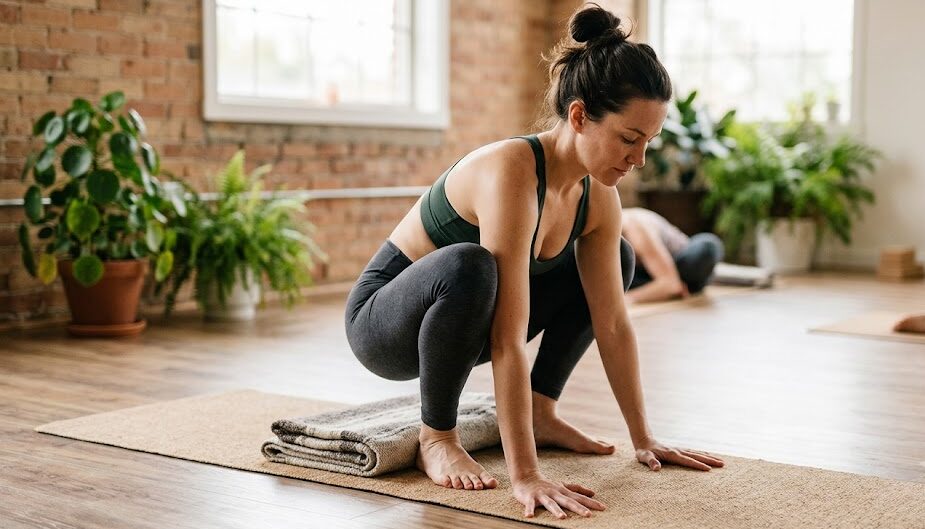
5. Supported Malasana with Hands on the Floor:
Place the hands on the floor in front of you instead of bringing the palms together.
This reduces the balance challenge and allows you to focus on the hips, ankles, and breathing.
Best for: beginners and mobility practice.
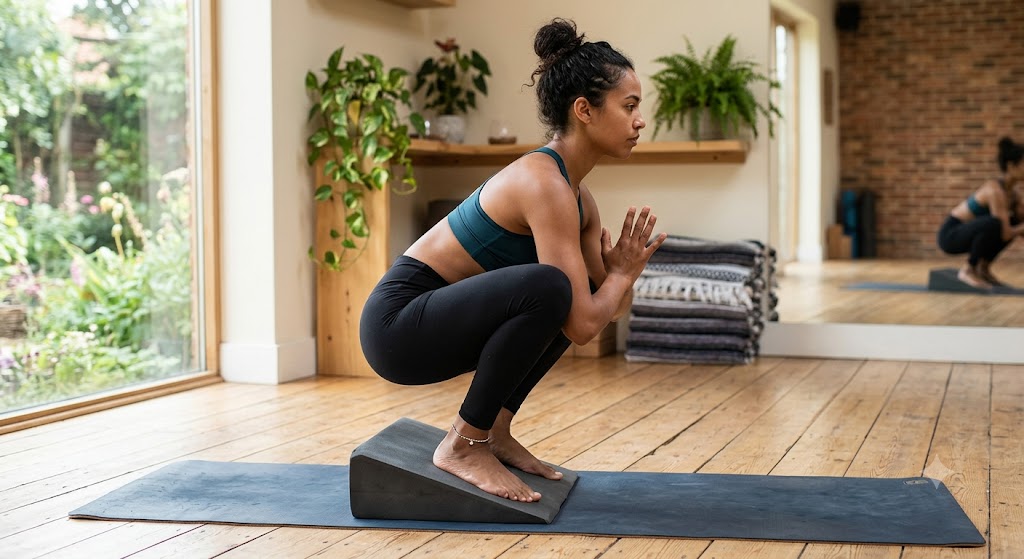
6. Malasana with Heels Elevated:
Use a folded blanket, wedge, or other stable support beneath the heels.
This reduces the ankle dorsiflexion requirement and can allow a deeper, more comfortable squat.
Do not use an unstable object.
Best for: people whose heels lift because of ankle-mobility limitations.
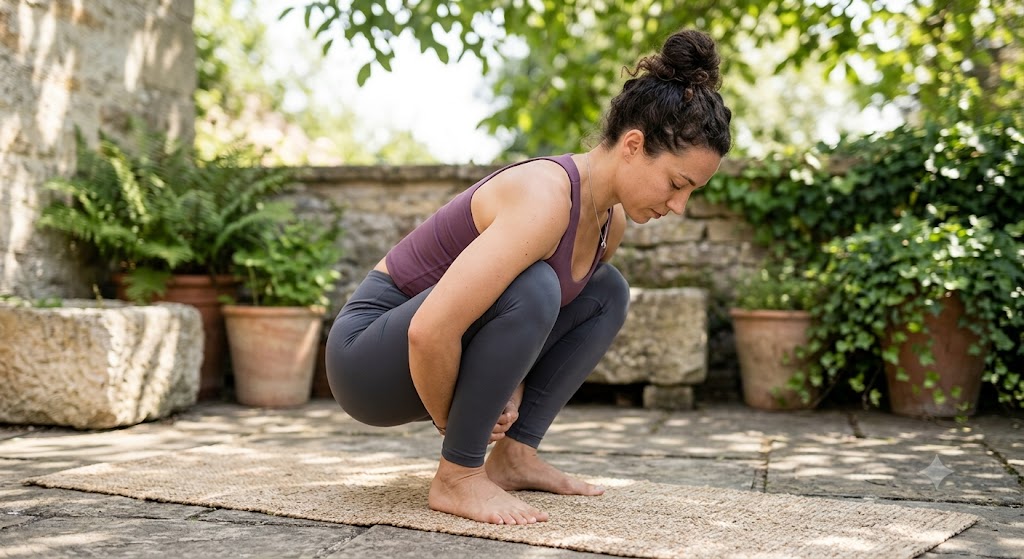
7. Bound Malasana:
Once you are comfortable in regular Malasana, you can explore the traditional bound variation.
From the squat, bring the arms around the legs and work toward clasping the hands behind the body.
Do not force the bind.
The bind is optional; it is not necessary to receive the basic benefits of Malasana.
Best for: experienced practitioners with comfortable shoulder, hip, and ankle mobility.
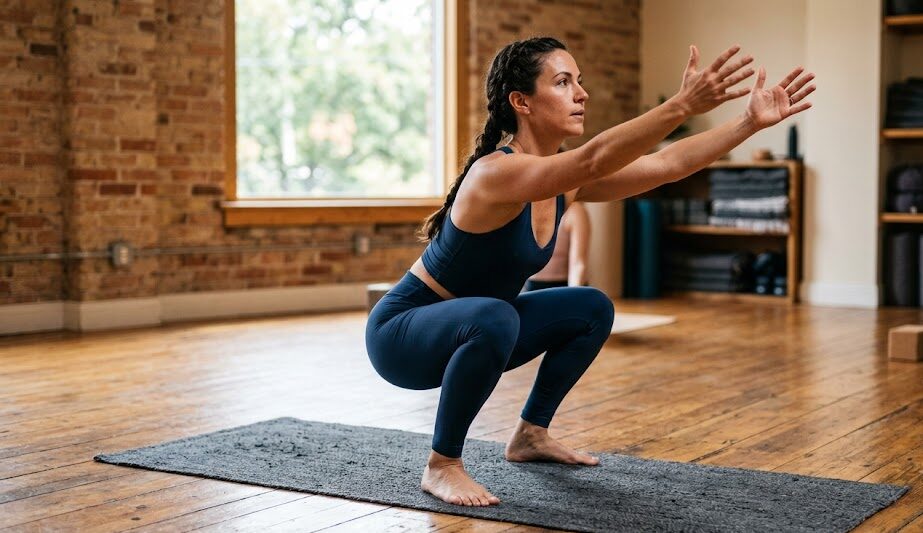
8. Dynamic Malasana:
Instead of holding the pose, slowly move between a comfortable standing position and a supported squat.
Move with the breath and maintain control.
This turns Malasana into a simple mobility exercise rather than a static hold.
Best for: warm-ups and people who prefer movement to long static holds.
Malasana and Constipation: What Does the Science Say?
One of the most interesting reasons people practice a deep squat is its similarity to a squatting toilet posture.
When you squat deeply, the hips become more flexed than they are on a conventional toilet. This changes the relationship between the rectum, pelvis and pelvic-floor muscles.
A small physiological study compared normal sitting, a more hip-flexed sitting position and squatting. During squatting, researchers observed a wider rectoanal angle of about 126° compared with 100° in normal sitting and lower baseline abdominal pressure. The authors suggested that greater hip flexion may make the anorectal canal straighter and potentially reduce the effort required for defecation.
That provides a plausible explanation for why some people find a more squat-like toilet position easier.
However, this does not mean that practicing Malasana will cure chronic constipation.
A 2023 randomized trial found that using a toilet footstool did not improve simulated defecation in an undifferentiated group of patients with constipation, showing that the relationship between posture and constipation is more complicated than “squat = cure.”
A 2025 scoping review similarly concluded that squatting may influence bowel evacuation, but the existing evidence has important methodological limitations and does not establish definitive long-term health benefits.
So, is Malasana good for constipation?
It may be comfortable and potentially helpful for some people, particularly because it trains the body to become comfortable in a deep hip-flexed position.
But Malasana should not replace evidence-based treatment for persistent constipation. Chronic constipation can have many causes, and treatment may involve dietary changes, fiber, medication, behavioral strategies, or evaluation for pelvic-floor dysfunction. Current gastroenterology guidelines recommend evidence-based approaches such as fiber and appropriate pharmacological treatments when indicated.
A practical toilet-posture tip
You do not need to perform Malasana on the bathroom floor.
If you use a Western-style toilet, placing the feet on a stable footstool can increase hip and knee flexion and make your posture more squat-like.
Keep the stool stable, avoid straining excessively, and stop if the position causes pain or dizziness.
Malasana vs a Normal Gym Squat
Although both movements involve squatting, their goals are different.
| Malasana | Gym Squat |
|---|---|
| Usually held as a static posture | Usually performed through repetitions |
| Primarily used for yoga/mobility practice | Often used for strength and hypertrophy |
| Usually unweighted | May use a barbell, dumbbells, or other resistance |
| Hands may be at the chest or used for support | Hands usually hold or stabilize a load |
| Emphasizes comfortable deep positioning and breathing | Emphasizes controlled force production |
| Often practiced at a self-selected depth | Depth and load may be programmed |
| Can be modified extensively with yoga props | Usually modified according to training goals |
A gym squat can be a highly effective strength exercise, while Malasana can be used as a mobility, balance and positional practice.
Neither is automatically “better.”
Squat biomechanics change with stance width, foot position, trunk position, depth and load. A 2024 biomechanical review highlights that these variables alter joint loading and muscular demands.
If your goal is strength, progressive resistance training is more appropriate than simply holding Malasana.
If your goal is comfortable deep-squat mobility, Malasana may be a useful yoga-based option.
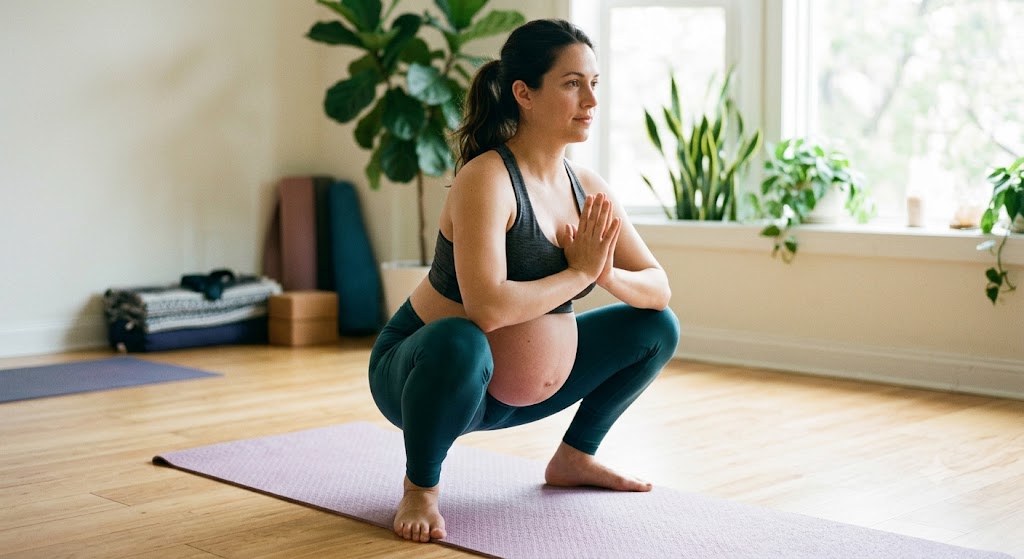
Malasana During Pregnancy:
Pregnancy changes balance, joint loading, abdominal pressure, and available space around the pelvis. Therefore, Malasana should be adapted rather than automatically prescribed during pregnancy.
For women with uncomplicated pregnancies, physical activity is generally encouraged, although exercise may need to be modified as pregnancy progresses. The American College of Obstetricians and Gynecologists specifically notes that prenatal yoga classes commonly use modified poses to accommodate changing balance.
Can Malasana help prepare for childbirth?
It can be reasonable to use a comfortable, supported squat as part of general movement preparation, provided your obstetric or maternity-care team has not advised against it.
But we should be careful with claims that Malasana “opens the pelvis,” “guarantees an easier birth” or “prevents tearing.”
Evidence on squatting and upright positions during labour is mixed.
A systematic review and meta-analysis of seven randomized trials involving 1,219 women found no clear overall benefit of squatting for the duration of the second stage of labour and concluded that women should be able to choose the position they prefer.
Other trials have reported potential benefits from squatting or upright positions, including fewer instrumental deliveries or shorter second-stage labour, but these findings have not been consistent across studies.
Therefore, think of prenatal Malasana as movement practice, not childbirth insurance.
Malasana and the Root Chakra (Muladhara):
In traditional yoga philosophy, Malasana is often associated with the Muladhara (root) chakra, located at the base of the energetic body.
Muladhara is traditionally associated with themes such as:
- Grounding
- Stability
- Safety
- Physical presence
- Connection to the earth
These are traditional yogic concepts, not anatomical or medically established mechanisms.
Practicing Malasana mindfully can certainly be used as a grounding meditation: feel the feet against the floor, notice the breath, soften unnecessary tension, and become aware of your physical connection with the ground.
You don’t need to accept the chakra system literally to benefit from this mindful approach.
Philosophy & Origin Of The Malasana:
There are a lot of attempts at the translation of the Malasana as the “Garland Pose.” Where mala is most frequently referred to as a rosary or a garland or a necklace, many learners have difficulty understanding how the imaginings apply to this yoga pose.
Some instructors say that the outline of our body portrays the beads of a mala, or possibly our arms appear like a garland, i.e., a mala hanging from our neck.
Other instructors say that this posture is conventionally taken while receiving a gift or a garland from a divine person.
An interesting yet lesser-known aspect of the yoga squat, Malasana, sheds more light on its significance. The term “Mala” translates to excrement. Considering the pose’s digestive benefits, this interpretation seems fitting, doesn’t it?
Final Thoughts:
Malasana is more than simply “sitting in a squat.” It combines ankle mobility, knee and hip flexion, balance, strength, breathing, and body awareness in one compact posture.
For some people, the traditional pose will feel natural. For others, a blanket under the heels, a block beneath the pelvis, or support from a wall will make a significant difference.
The goal is not to force yourself into the deepest possible squat. The goal is to find a version of Malasana that your body can perform comfortably, safely, and consistently.
FAQs:
Q. Is Malasana Helpful For Weight Loss?
A. YES. Malasana indeed is effective in losing weight, especially as this asana works best for a toned belly. Practice this asana to get a toned belly.
Q. What does Malasana mean?
A. ‘Mala’ means garland, rosary, or necklace, and ‘Asana’ means Yoga pose. So Malasana means Garland Pose.
Q. What is the best time to do Malasana?
A. The best time to practice Malasana is in the early morning. It is better to practice on an empty stomach.
Q. Is The Asana Effective for Knee and Back Pain?
A. Of course, it gives relief from knee pain and back pain.
Q. When is the best time to practice the Malasana?
A. Dawn is the best time to practice the Malasana, as then we can practice the asana on an empty stomach.
Q. Can I do Malasana in pregnancy?
A. Many women with uncomplicated pregnancies can continue modified exercise, but Malasana should be adapted for comfort and balance. A wider stance, wall support, or a block can make the pose easier.
Q. Malasana vs squat: What’s the difference?
A. Malasana is essentially a yoga-based deep squat, usually practiced as a held posture with emphasis on breathing, mobility, and awareness.
A gym squat is generally performed dynamically and may be loaded with weights to develop strength and muscle.
They overlap biomechanically, but they have different training purposes.
Q. Why can’t I keep my heels down in Malasana?
A. Limited ankle dorsiflexion is one common reason, although hip mobility, knee mobility, body proportions, strength, and balance can also contribute. Research shows that ankle and hip range of motion are associated with squat depth.
Q. How long should I hold Malasana?
A. Start with 15-30 seconds and gradually build toward 30-60 seconds if comfortable.