
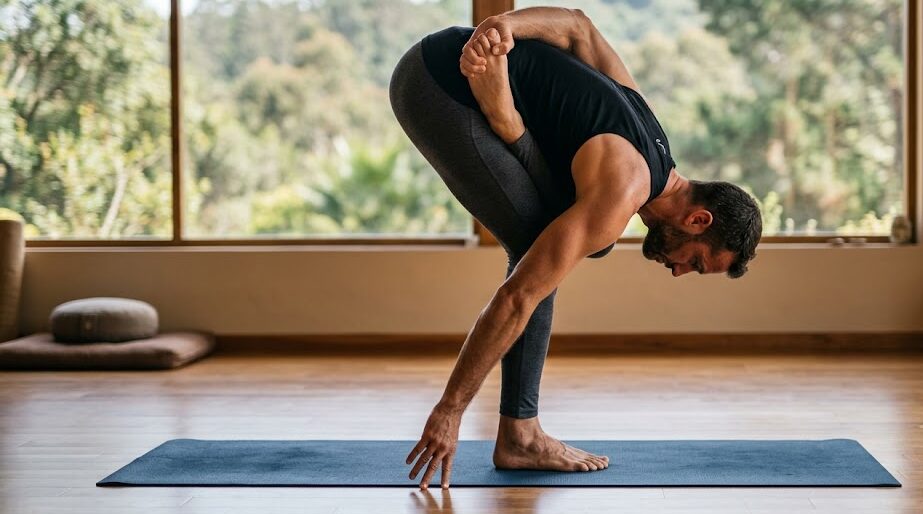
Sanskrit Name: Ardha Baddha Padmottanasana (अर्ध बद्ध पद्मोत्तासन)
English Name: Half Bound Lotus Standing Forward Bend
Type of Yoga: Ashtanga Yoga
Level of Yoga: Advanced / Intermediate
Duration: 30 to 60 seconds or as per your Capacity
Target Area: Stomach, Leg, thigh
Strengthens: Hamstrings, Hips, Knees, and Shoulders
This seat is a stand-up balancing pose. In the beginning, it can be a bit difficult to perform this posture, but you can easily do this asana by practicing regularly. Many mental and emotional problems will be improved and balanced by the regular practice of Ardha Baddha Padmottanasana. It provides strength to the hips, shoulders, hamstrings, and knees.
Table of Contents
What Does Ardha Baddha Padmottanasana Mean?
Ardha Baddha Padmottanasana is also called the Half Bound Lotus Standing Forward Bend in the English language. The name of Ardha Baddha Padmottanasana is composed of five Sanskrit language words, where
The first word is “Ardha (अर्ध)”, which means “Half”
Then the second word is “Baddha (बद्ध)”, which means “Bound”
The third word is “Padma (पद्म)”, which means “Lotus”
Then the fourth word is “Uttana (उत्तान)”, which means “Standing Forward Bend”
And finally, the fifth word is “Asana (आसन)”, which means “Yoga Pose”.
Ardha Baddha Padmottanasana, also known as Half Bound Lotus Standing Forward Bend Pose, is an intermediate to advanced posture found in the Ashtanga Yoga Series. This pose involves deep stretching and extension of the entire body in a forward-bending motion.
Ardha Baddha Padmottanasana is a standing balance and forward-bending yoga posture commonly translated as Half Bound Lotus Standing Forward Bend. It combines balance, hip mobility, hamstring flexibility, shoulder mobility, and concentration.
The pose is part of the Ashtanga Yoga Primary Series, where it appears in the standing sequence. Because it combines a half-lotus leg position, a behind-the-back bind, a forward fold, and balancing on one leg, it is considered an intermediate-to-advanced posture.
Beginners do not need to perform the full expression of the pose. The safest approach is to build it progressively.
Let’s now discuss the method of doing Ardha Baddha Padmottanasana properly as well as its precautions, preparatory poses, follow-up poses, beginner’s tips, and benefits below:
Preparatory Poses of Ardha Baddha Padmottanasana:
- Utthita Parsvakonasana (उत्थित पार्श्वकोणासन) or Extended Angle Pose
- Prasarita Padottanasana (प्रसारित पादोत्तासन) or Wide-Legged Forward Bend
- Parivrtta Parsvakonasana (परिवृत्त पार्श्वकोणासन) or Revolved Side Angle Pose
- Utthita Hasta Padangusthasana (उत्थित हस्त पादंगुष्ठासन) or Extended Hand-To-Big-Toe Pose
- Parsvottanasana (पर्श्वोत्तनासन) or Intense Side Stretch Pose
- Vrikshasana (वृक्षासन) or Tree Pose
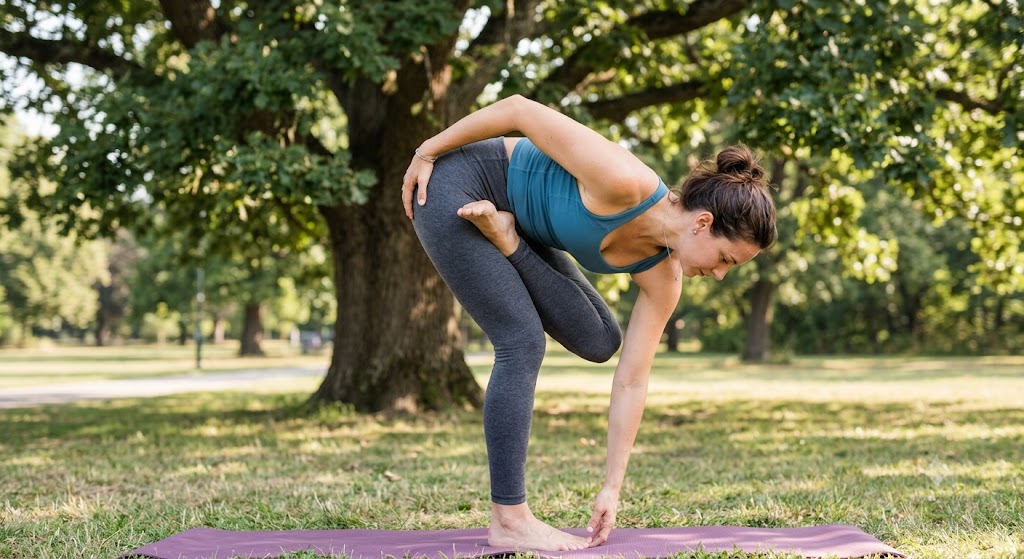
Method of doing Ardha Baddha Padmottanasana:
- At first, stand in Tadasana or Mountain Pose
- Inhale, lift your left leg, and bring the left foot onto the right thigh and bring it as much as possible
- In this posture, you will get a stretch on your left hip and knee (Keep the focus on your right leg to maintain balance)
- If the foot is sliding downwards, then you can hold it with the right hand
- Now take your left hand from the back and hold the left toe
- Learn the joints of the hip, leaving the breath – be careful not to bend the joints of the waist or knee joints
- Breathe while bending down
- Place your left hand on the ground beside your left foot
- Take five breaths in total and leave them out so that you can stay in the asana for 30 to 60 seconds
- Gradually, as your strength and flexibility in your body increase, you can increase the time (do not exceed 90 seconds)
- Try to keep your back straight, and keep the left leg straight
- Let your head hang tight so that your neck muscles are not stressed
- After breathing 5 times, you can come out of this posture
- After practicing the asana on the left side, repeat all the steps on the right side too
Beginner’s Tips:
In case your hand does not come fully behind the back, then you will not be able to hold the toe. If this is the case, keep your hands on the back and do not force it forward.
In case your foot does not reach the top of the thigh, you will not be able to hold the toe. If this is so, bring the feet upward as much as possible and do not force them, and lean forward a little to hold the toe
Follow-up Poses of Ardha Baddha Padmottanasana:
- Dandasana (दंडासन) or Staff Pose
- Utkatasana (उत्कटासन) or Chair Pose
- Virabhadrasana 1 (वीरभद्रासन 1) or Warrior Pose 1
- Virabhadrasana 2 (वीरभद्रासन 2) or Warrior Pose 2
Modification Ladder: Progress Gradually
You do not need to achieve the full bind immediately. Use the following progression:
Level 1: Upright Version
Begin by standing on one leg with the other foot placed in a comfortable half-lotus or modified position.
Stay upright without folding forward.
This develops:
- Balance
- Hip mobility
- Leg stability
- Concentration
Level 2: Hold the Foot With Your Hand
Once the upright position is comfortable, use the opposite or appropriate hand to support the lifted foot rather than reaching behind the back for the full bind.
This allows you to work on balance and hip positioning without demanding as much shoulder mobility.
Level 3: Use a Block Under the Hand
Keep the foot supported and fold forward while placing the free hand on a yoga block.
Start with the block at its highest setting. As your balance and mobility improve, you can gradually lower the block.
This is preferable to reaching the floor by rounding the spine or collapsing into the standing leg. Props can make the pose more accessible without forcing your body into its deepest position.
Level 4: Full Bind
Only when the previous stages are comfortable should you work toward reaching the foot behind your back and holding it while folding forward.
The full version requires a combination of:
- Hip external rotation
- Shoulder mobility
- Hamstring flexibility
- Balance
- Core and leg control
There is no requirement to reach this stage. A modified version can still provide a useful yoga practice.
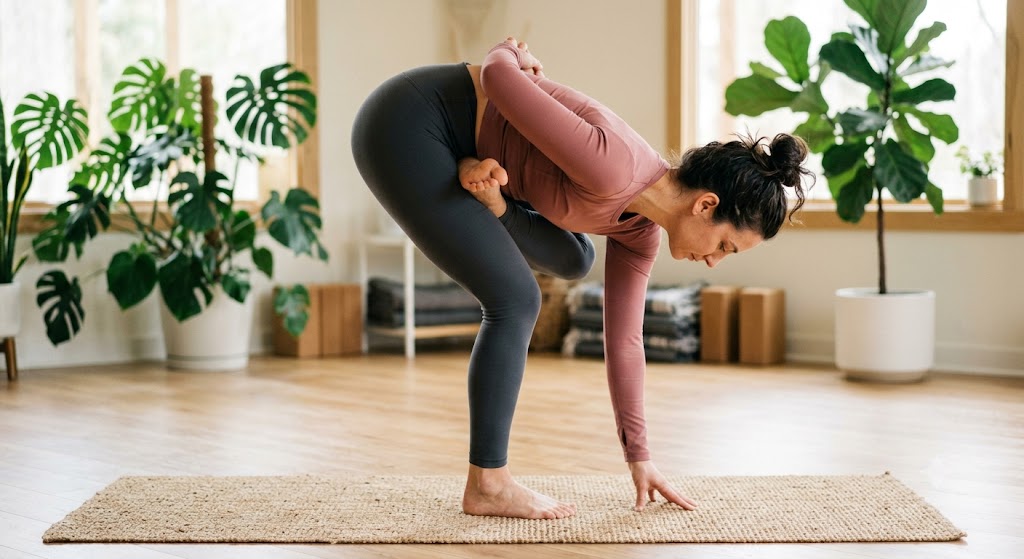
Precautions and Contraindications Of Ardha Baddha Padmottanasana
Ardha Baddha Padmottanasana requires particular care because it combines balancing, forward bending, hip rotation, and a half-lotus position.
- Avoid the pose or seek guidance from a qualified professional if you have a current knee or hip injury.
- Because the pose involves a forward-folded position with the head below the heart, people with glaucoma should avoid the full forward-folded version unless their eye-care professional has specifically cleared it.
- If you have high blood pressure, particularly if it is uncontrolled, seek medical guidance before practicing deep forward bends or inverted positions.
- People prone to low blood pressure, dizziness, or fainting should use extra caution. Rising from a forward fold while balancing on one leg can make some people feel unsteady.
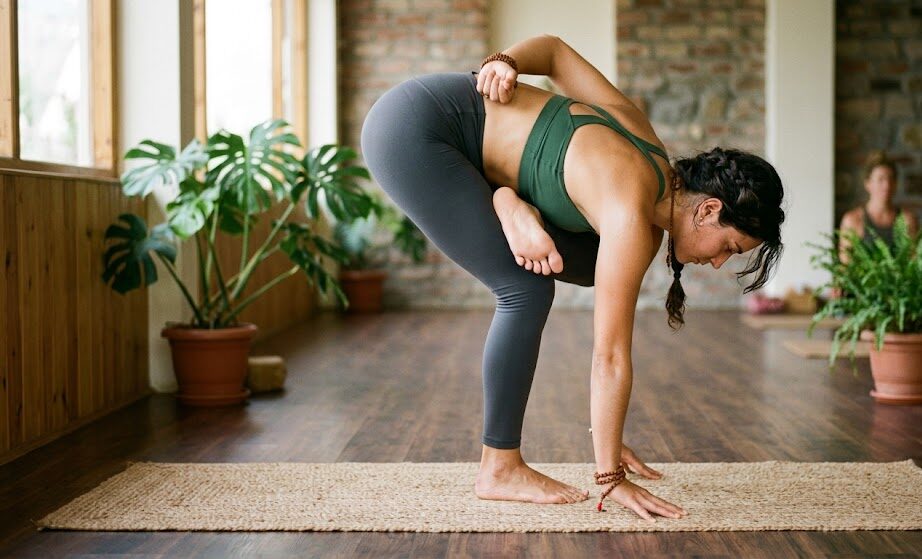
Benefits of Ardha Baddha Padmottanasana:
The Ardha Baddha Padmottanasana tests and refines the practitioner’s ability to maintain equilibrium and concentration. For a beginner, the posture could be challenging, but with consistent practice, it can be mastered. See below the benefits of Ardha Baddha Padmottanasana.
Improves Flexibility:
It is an extended position. It entails hip, hamstring, ankle, shoulder, and arm stretches. Stretching muscles increases their flexibility. One’s range of motion, joint mobility, and agility are all improved by lifting and folding one leg like in Ardha Padmasana. While employing the pelvic and psoas muscles, balancing the entire body weight on one side helps to strengthen the leg and increase the flexibility of the affected joints and muscles. The lower back opens up as a result of the hip forward bends, stretching the surrounding muscles and increasing the flexibility of the entire spine.
Enhanced Digestion:
The folded foot of Ardha Baddha Padmottanasana reaches the stomach during the forward bend. The abdominal organs contract as a result of the pressure. As a result, the digestive system is stimulated and begins to secrete digestive fluids. Additionally, it cures gastric disorders.
Facilitates Respiration:
When the hand grips the toe from behind, the standing half-bound lotus stance enlarges and opens up the chest. It aids in respiratory organ enlargement, which enhances the respiratory system’s performance. With the core and abdominal muscles contracted in Ardha Baddha Padmottanasana, the breath is first influenced, occasionally making it difficult to breathe deeply. The hand’s binding movement opens the front of the body by enlarging the chest and shoulders and guiding the breath. The chest widens as a result, allowing the intercostal muscles greater room to expand. Therefore, breathing is improved with breath awareness, which finally aids in maintaining balance in the pose.
Increases Concentration:
The root chakra (Muladhara) opens up as a result of maintaining equilibrium during the forward bend. Consistently performing this stance improves their feeling of equilibrium, focus, and concentration. As a result, it also enhances self-awareness.
Awakens Body Chakra:
The position also activates the sacral chakra since it involves the abdominal cavity. It strengthens the practitioner’s reproductive system and emotional well-being. The forward bend’s movement activates the Solar Plexus Chakra while also stimulating the Ajna Chakra to maintain equilibrium in the body. The inverted position of the head also stimulates the Crown Chakra.
Stimulates Nervous System:
Ardra Baddha Padmottanasana involves lowering the head to the ground. It increases the amount of blood flowing to the head and provides the brain’s cells with oxygen. The neurological system has a calming and soothing sensation as a result.
Stretches, Strengthens, Lengthens Body:
Due to the balanced nature of Ardha Baddha Padmottanasana, there is added pressure on the quadriceps, gluteus, hamstrings, and calves, as well as the hip, knee, and ankle joints. Along with the muscles of the arms and shoulders (binding one hand from behind), the legs, spine (stretched as it lengthens to move in a forward bend), core, and the associated muscles are all strengthened.
Makes Body Strong:
One will feel strong and cognitively and emotionally stable after integrating all of their body components in this stance. Additionally, if the mind drifts and leaves the body, alignment, and breath, equilibrium is lost. Thus, maintaining balance by distributing one’s weight evenly across all four corners of the grounded foot while purposefully keeping one’s body relaxed and breathing improves breathing and sharpens one’s sense of attention and concentration. To keep the knee safe while folding forward, it should also be forced down until it is vertical.
Stimulation and Organs:
In the final position, pulling the chest and core together to bring the chin nearly to the knee puts pressure on the belly, which in turn stimulates the body’s reproductive and digestive systems and facilitates better disposal. The abdomen and navel are pressed by the folded leg’s heel. This ignites the body’s Jatargni (metabolic fire). The body’s ability to digest food and absorb nutrients is improved by this stimulation.
Conclusion:
Regardless of how frightening Ardha Baddha Padmottanasana appears to be, it offers a number of advantages. This justifies trying the posture. For the same benefits, you can attempt this stance with simple tweaks & variations. Additionally, it remarkably rejuvenates the human body because it combines two asanas. It enhances the pose’s allure and benefits.
FAQs:
Q. Can beginners do Ardha Baddha Padmottanasana?
A. Yes, but beginners should not start with the full version. Begin with Tree Pose, then practice an upright modified version before progressing toward the foot hold, block-supported forward fold, and eventually the full bind.
Q. What if I can’t bind the foot?
A. You do not need to bind the foot. Stay upright, hold the foot with your hand, use a strap, or practice with the free hand on a block. The goal is controlled, comfortable practice, not forcing yourself into the final shape.
Q. Is Ardha Baddha Padmottanasana in the Ashtanga Primary Series?
A. Yes. Ardha Baddha Padmottanasana is part of the Ashtanga Yoga Primary Series and appears in its standing sequence.
Q. Does Ardha Baddha Padmottanasana improve digestion?
A. It may feel comfortable for some people because of the forward-folding and abdominal position, and traditional yoga teachings associate the posture with digestive benefits.
However, there is not enough evidence to claim that this pose treats digestive disorders or cures digestive problems. It should be presented as a yoga practice rather than a medical treatment.
Q. Who should avoid Ardha Baddha Padmottanasana?
A. People with current knee or hip injuries, uncontrolled high blood pressure, glaucoma, significant dizziness or fainting problems, or other conditions that make forward bending or balancing unsafe should avoid the full pose or seek appropriate medical and professional guidance first.